When evaluating storage tank solutions for municipal water systems, wastewater treatment plants, industrial facilities, agricultural operations, biogas projects, or fire protection applications, many buyers initially focus on purchase price. However, experienced project owners understand that the lowest upfront cost does not necessarily translate into the lowest overall investment.
A storage tank is a long-term asset expected to operate reliably for decades. Installation expenses, maintenance requirements, repair costs, operational downtime, and replacement cycles can dramatically affect the total cost of ownership over the tank's lifespan.
This raises a critical question for engineers, procurement managers, EPC contractors, and facility operators:
Which storage tank has the lowest lifetime cost?
The answer depends on several factors, including project requirements, environmental conditions, maintenance strategies, and expected service life. This article examines the major storage tank technologies available today and compares their lifetime costs to help buyers make informed procurement decisions.
Understanding Lifetime Cost vs Initial Purchase Price
Lifetime cost, often referred to as Total Cost of Ownership (TCO), includes every expense associated with a storage tank throughout its operational life.
These costs typically include:
Tank procurement
Transportation
Site preparation
Installation
Engineering and design
Routine inspections
Maintenance
Repairs
Replacement components
Operational downtime
Rehabilitation projects
Tank replacement
A tank with a lower purchase price may require substantial maintenance and repair expenditures over time, resulting in a significantly higher total lifecycle cost.
Therefore, procurement decisions should be based on long-term value rather than initial cost alone.
The Major Storage Tank Types Compared
The most common storage tank solutions used in municipal and industrial projects include:
Concrete Tanks
Welded Steel Tanks
Epoxy-Coated Steel Tanks
Stainless Steel Tanks
Glass Fused to Steel Tanks
Fiberglass Reinforced Plastic (FRP) Tanks
Polyethylene Tanks
Each option has a unique cost profile over its lifespan.
Concrete Tanks
Initial Investment
Concrete tanks often require extensive site work, formwork, reinforcement, and onsite construction.
Initial costs can be relatively high, particularly for large municipal projects.
Maintenance Costs
Over time, concrete structures may experience:
Cracking
Water infiltration
Joint deterioration
Chemical attack
Reinforcement corrosion
These issues often require:
Structural inspections
Waterproofing repairs
Crack injection
Concrete rehabilitation
Service Life Considerations
While concrete tanks can remain operational for decades, major refurbishment projects are frequently required during their lifespan.
Lifetime Cost Assessment
Although concrete tanks are durable, maintenance and rehabilitation costs can substantially increase long-term ownership expenses.
Lifetime Cost Rating: Moderate to High
Welded Steel Tanks
Initial Investment
Welded steel tanks generally have lower construction costs than large concrete structures.
However, field welding and coating application increase labor requirements.
Maintenance Costs
The primary challenge is corrosion control.
Typical maintenance activities include:
Surface preparation
Repainting
Corrosion repair
Weld inspections
Coating replacement
Service Life Considerations
Without regular maintenance, corrosion can significantly reduce service life.
Lifetime Cost Assessment
Frequent coating maintenance often increases overall ownership costs.
Lifetime Cost Rating: High
Epoxy-Coated Steel Tanks
Initial Investment
Epoxy-coated steel tanks generally offer competitive purchase pricing.
Maintenance Costs
Although epoxy coatings provide corrosion protection, they eventually degrade due to:
UV exposure
Chemical attack
Mechanical damage
Aging
Maintenance often involves:
Spot repairs
Recoating
Surface preparation
Service Life Considerations
Periodic coating renewal is usually required throughout the tank's operational life.
Lifetime Cost Assessment
Maintenance costs are lower than traditional painted steel tanks but remain significant over time.
Lifetime Cost Rating: Moderate to High
Stainless Steel Tanks
Initial Investment
Stainless steel tanks typically have one of the highest initial costs among available storage solutions.
Material costs alone can significantly exceed those of carbon steel alternatives.
Maintenance Costs
Stainless steel provides excellent corrosion resistance and generally requires:
Routine inspections
Cleaning
Passivation when necessary
Service Life Considerations
Properly maintained stainless steel tanks can achieve long operational lives.
Lifetime Cost Assessment
Low maintenance costs help offset the high initial investment, but overall ownership costs often remain substantial because of the premium material expense.
Lifetime Cost Rating: Moderate
Fiberglass Reinforced Plastic (FRP) Tanks
Initial Investment
FRP tanks are often competitively priced for small and medium-sized applications.
Maintenance Costs
Potential maintenance concerns include:
UV degradation
Surface cracking
Resin aging
Mechanical damage
Service Life Considerations
Service life varies significantly depending on environmental conditions and stored media.
Lifetime Cost Assessment
FRP tanks offer reasonable lifecycle performance in suitable applications but may require repairs as materials age.
Lifetime Cost Rating: Moderate
Polyethylene Tanks
Initial Investment
Polyethylene tanks generally offer the lowest upfront cost.
Maintenance Costs
Maintenance requirements are typically minimal.
However, material limitations may result in:
UV degradation
Structural deformation
Reduced lifespan
Service Life Considerations
Polyethylene tanks are usually best suited for smaller-scale applications.
Lifetime Cost Assessment
Although inexpensive initially, shorter service life may increase replacement frequency.
Lifetime Cost Rating: Moderate
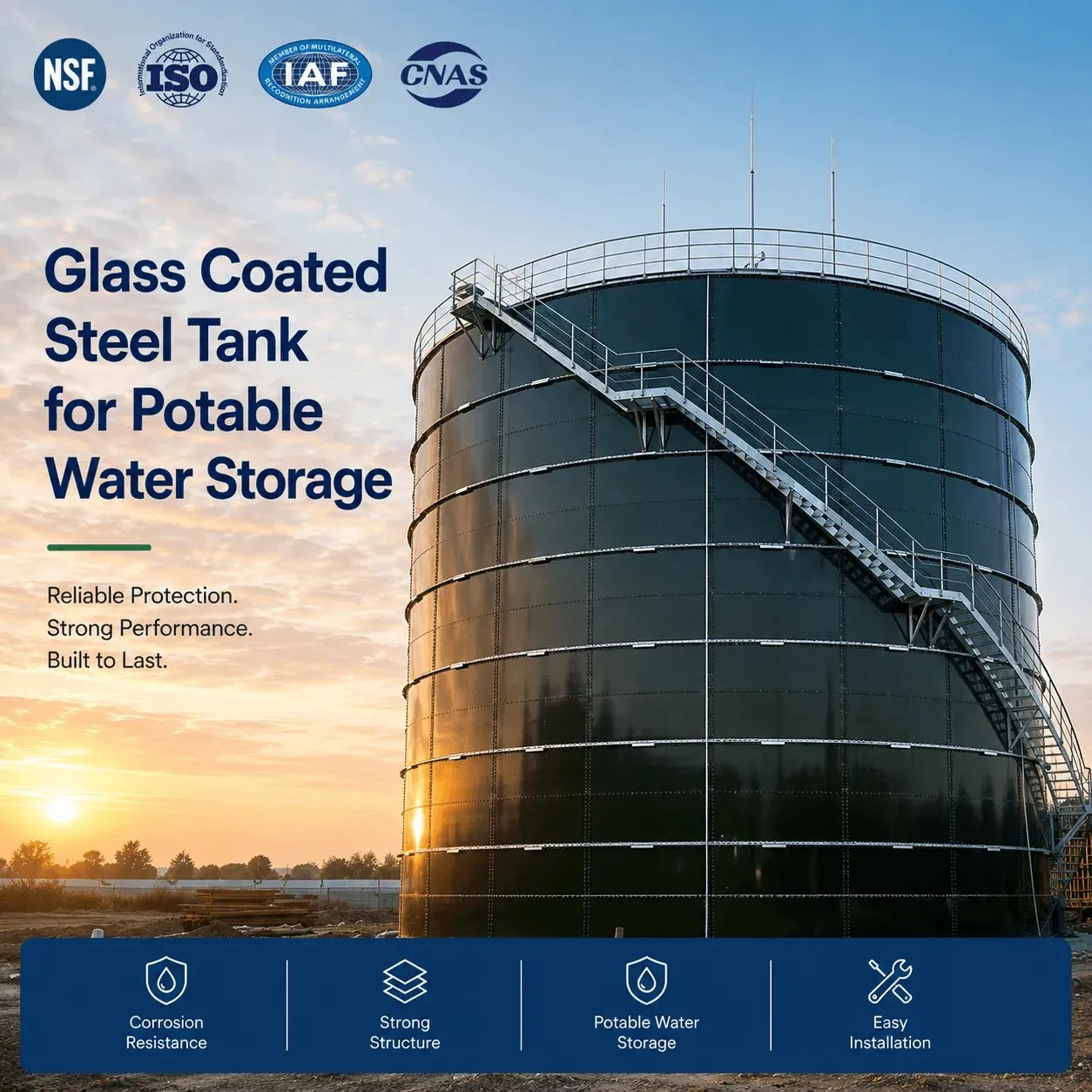
Glass Fused to Steel Tanks
Initial Investment
Glass Fused to Steel (GFS) tanks often fall within the mid-range of initial project costs.
While they may cost more than some basic steel systems, they generally require less site work than concrete structures and offer faster installation.
Maintenance Costs
One of the biggest advantages of GFS technology is its exceptionally low maintenance requirement.
The glass coating is permanently fused to the steel surface at temperatures exceeding 800°C, creating a durable barrier against corrosion and chemical attack.
Typical maintenance activities include:
Visual inspections
Bolt checks
Roof inspections
Accessory maintenance
Unlike many alternative systems, GFS tanks generally do not require:
Repainting
Recoating
Major corrosion repairs
Service Life Considerations
High-quality GFS tanks are commonly designed for service lives exceeding 30 years under demanding operating conditions.
Lifetime Cost Assessment
The combination of:
Low maintenance
Long service life
Minimal downtime
Reduced repair costs
Fast installation
often results in one of the lowest total ownership costs among large-scale storage tank technologies.
Lifetime Cost Rating: Very Low
The Hidden Costs Buyers Often Overlook
Many procurement teams focus exclusively on quoted tank prices while overlooking expenses that emerge later.
Downtime Costs
When tanks require major repairs, operations may be interrupted.
This can result in:
Lost production
Service disruptions
Emergency repair expenses
Labor Costs
Maintenance-intensive tanks require ongoing labor resources.
Over decades, labor expenses can exceed initial equipment costs.
Corrosion-Related Failures
Corrosion remains one of the most expensive issues affecting storage infrastructure.
Repairing corrosion damage often involves:
Surface preparation
Coating replacement
Structural reinforcement
Component replacement
Expansion Costs
Growing populations and increasing production demands often require additional storage capacity.
Modular tank technologies can significantly reduce future expansion costs.
Example of a 30-Year Cost Perspective
Consider two storage tank options:
Option A
Lower purchase price
Frequent coating maintenance
Periodic rehabilitation
Higher downtime risk
Option B
Moderate purchase price
Minimal maintenance
Longer service life
Reduced repair requirements
Although Option A appears less expensive initially, cumulative maintenance and repair expenses may result in a significantly higher total ownership cost over 30 years.
This is why sophisticated project owners increasingly evaluate lifecycle costs rather than procurement costs alone.
Factors That Influence Lifetime Cost
No tank technology is universally ideal for every project.
Lifetime cost depends on:
Environmental Conditions
Coastal environments
High humidity
Extreme temperatures
UV exposure
Stored Contents
Drinking water
Wastewater
Sludge
Chemicals
Digestate
Installation Quality
Poor installation practices can dramatically increase maintenance and repair expenses.
Manufacturer Quality
Tank performance is heavily influenced by manufacturing standards, engineering expertise, and quality control procedures.
Which Storage Tank Delivers the Lowest Lifetime Cost?
For many municipal, industrial, wastewater, and biogas applications, Glass Fused to Steel tanks consistently rank among the lowest-cost solutions when evaluated across their entire operational lifespan.
Their advantages include:
Low maintenance requirements
Excellent corrosion resistance
Long service life
Reduced downtime
Rapid installation
Lower rehabilitation costs
Flexible future expansion
While project-specific requirements must always be considered, many owners find that the combination of durability and low maintenance delivers superior long-term economic value.
Conclusion
The storage tank with the lowest purchase price is not necessarily the storage tank with the lowest lifetime cost. Concrete tanks often require significant rehabilitation, welded steel systems demand ongoing corrosion protection, and epoxy-coated tanks eventually need recoating. Stainless steel offers excellent durability but comes with a substantial initial investment.
When evaluating total ownership costs over 20 to 40 years, factors such as maintenance frequency, repair requirements, operational downtime, corrosion resistance, and service life become far more important than procurement cost alone.
For many water, wastewater, industrial, and agricultural applications, Glass Fused to Steel tanks provide one of the most cost-effective long-term solutions available, combining durability, low maintenance, and reliable performance throughout their operational life.
For project owners seeking storage systems that maximize return on investment while minimizing lifecycle costs, Wansheng delivers engineered storage tank solutions designed for long-term reliability, operational efficiency, and sustainable value across diverse infrastructure applications.